Translate the public duty list into concrete questions about service, preparation, teamwork and physical work.
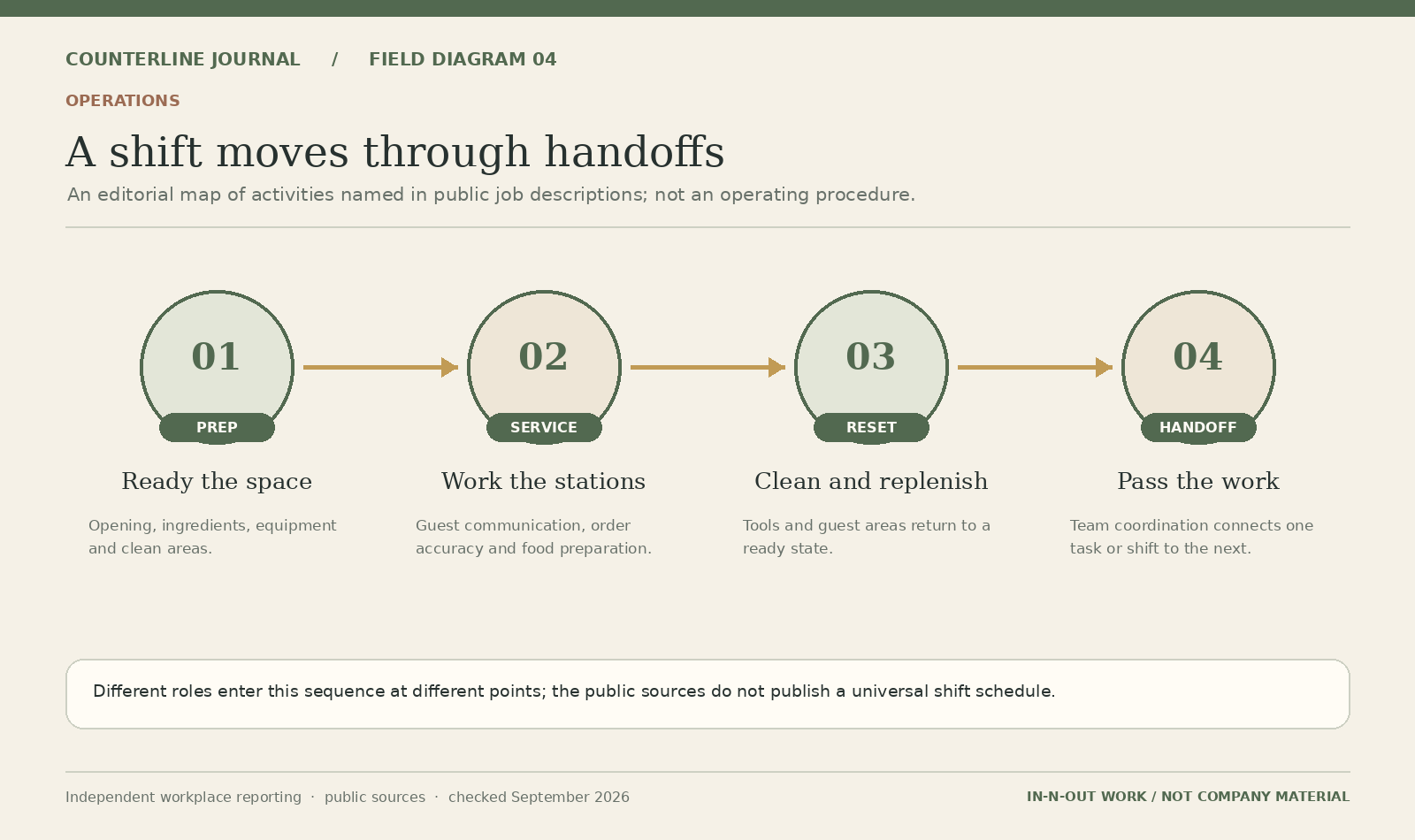
Store Associate work is broader than a cash-register assignment. The public description brings together customer communication, accurate records, basic math, equipment use and movement between work areas. The practical question for an applicant is how those responsibilities are introduced and combined at the location offering the job.
Read the duties as responsibilities
| Responsibility | What to clarify with the hiring team |
|---|---|
| Communication and accuracy | How are new associates taught order details and when should a question be escalated? |
| Cash handling and records | What instruction is provided before handling transactions or time records? |
| Station and equipment work | Which tasks will be taught first, and who demonstrates safe use? |
| Teamwork and feedback | Who is the training contact and how is readiness discussed? |
| Movement and lifting | What does the listed physical task look like on a normal assignment? |
The employer specifically lists English communication, basic math, following instructions, punctuality and teamwork. It also lists a 50-pound lifting requirement and equipment including slicers, dicers, terminals, fryers and grills. This is a summary of the public description, not a statement that a new hire immediately operates every item.
A listed maximum does not describe a whole shift
The lifting figure does not state how often a task occurs, the shape of the load or what assistance is available. Likewise, an equipment list does not establish a training sequence. Ask about the actual work rather than trying to infer the shift from a single number. The company’s job page also describes an accommodation process; use that employer route if needed.
Bring examples that fit the work
For an interview, think of a real situation where you followed a multi-step instruction, corrected an error or worked with someone during a busy period. Explain what you did and the result. A modest example you can discuss honestly is more useful than claiming you already know a restaurant’s internal method.
If you have never worked in food service, separate unfamiliarity from unwillingness to learn. You can ask how station instruction is organized, what you should bring to the first shift and how to get help when you are unsure. The onboarding preparation guide turns those questions into a short conversation plan.
Where development fits
The published level map is the place to read the employer’s station labels. It helps distinguish learning a task from earning a new level. Ask the store how practice and evaluation work locally; the public duty list does not provide a pass score or number of shifts to promotion.
When comparing this role with Clean-Up or Cookout work, keep the worksite, starting time and responsibilities visible. A shared employer does not make the roles interchangeable.