The employer’s station sequence, including the important differences between Levels 3, 4, 6 and 7.
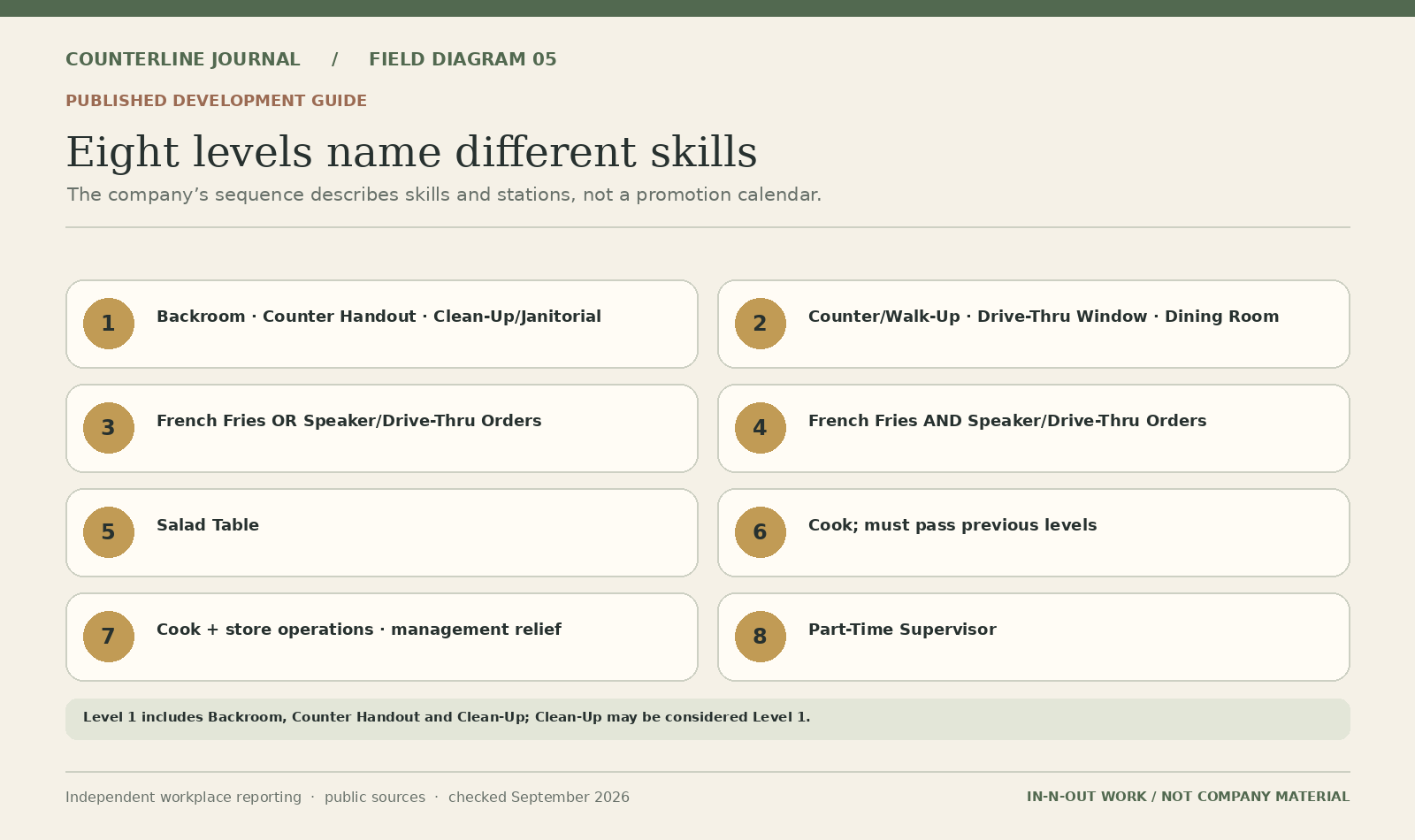
In-N-Out publishes an eight-level restaurant development guide. Read it as a map of named capabilities. It does not assign a number of days to each stage, show a pay increment for each level or promise that every worker will reach the same destination.
The published sequence
| Level | Published work or responsibility |
|---|---|
| 1 | Backroom; Counter Handout; Clean-Up/Janitorial* |
| 2 | Counter/Walk-Up Orders; Drive-Thru Window; Dining Room Service |
| 3 | French Fries OR Speaker/Drive-Thru Orders |
| 4 | French Fries AND Speaker/Drive-Thru Orders |
| 5 | Salad Table |
| 6 | Cook; must have passed all previous levels |
| 7 | Cook; prior levels and store-operations knowledge; management relief for meetings |
| 8 | Part-Time Supervisor |
*The company’s footnote says Clean-Up/Janitorial may be considered Level 1. Station labels in the table are the company’s terminology. The full source is linked below.
Three distinctions worth keeping
One station versus both. The “or” at Level 3 and “and” at Level 4 are meaningful. A summary that collapses both levels into “fries and drive-thru” loses the distinction the employer chose to publish.
Cooking and operational knowledge. Level 7 adds an operations and management-relief element beyond the Level 6 cooking description. It is not accurate to describe the two stages as identical just because each includes cooking.
A supervisor title is not a complete management ladder. Level 8 is Part-Time Supervisor. The separate Store Manager FAQ describes internal promotion, but these two pages do not publish every intervening title or appointment rule. See the management pathway discussion for that boundary.
Turn a level map into a development conversation
- Which specific capability should I work on next?
- What does ready look like, and who makes that assessment?
- What supervised practice is available?
- How should I ask for feedback after practice?
- Does the next assignment change my schedule or responsibilities?
These are editorial questions, not a company assessment form. Keep your own goals concrete: learning an unfamiliar task accurately is a better next step than guessing a promotion date from someone else’s story. If you receive an evaluation or instruction from your employer, that current instruction governs your own work.
The diagram accompanies the source; it does not replace it. For preparation before the first shift, read onboarding questions. For the broader nature of restaurant duties, see the Store Associate role.